

Interview: Paula Chamlee: An Artist of Complexity and "Natural Connection"
NY MoMA Hires Makeda Best as Its New Chief Photo Curator
Nearly 100 New Photographs Recently Added to the I Photo Central Website, Which Now Has Over 4,500 Photographs for Sale
Iconoclast, Provocateur and Innovator Duane Michals (1932-2026) Passes away
Photo Collector and Historian Jack Wilgus Passes away after a Fall
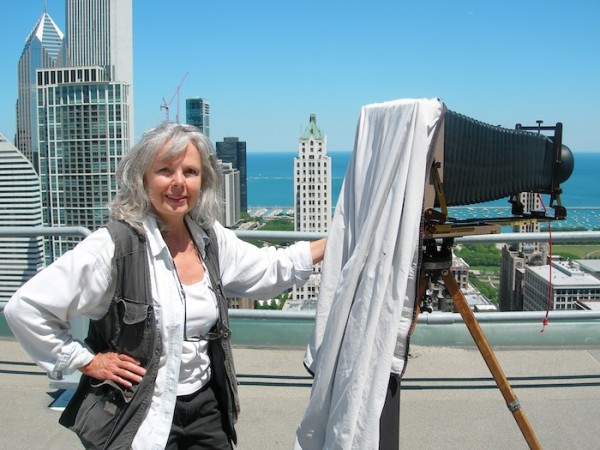
Paula Chamlee photographing in Chicago for the Chicago Lake/Chicago Loop series. Photo credit: Richard Boutwell.
In 1994, Lodima Press published Natural Connections: Photographs by Paula Chamlee, with an essay by Estelle Jussim. The title explained something of the working methods of Chamlee, straight photography with a deep connection to the subject matter, be it landscapes, still lifes or portraits. The book was exquisitely designed and printed, and published under the Lodima Press imprint owned by Chamlee and her late husband, photographer Michael A. Smith (1942–2018), who originated Lodima Press in 1981.
In addition to several books of their own work, Chamlee and Smith would go on to publish Lodima Press books by many other notable photographers, including Edward and Brett Weston, Larry Fink and Robert Adams. But their contributions to photography as a medium went way beyond that. They worked as teachers and held numerous workshops in the US and around the world. In 2013, they established a 501(c)(3) nonprofit organization called Arts of Our Time, with the purpose of fostering scholarship and creativity in photography and other arts. They donated their compound of four studios, libraries of photography and art books, and 28 acres in rural Bucks County, Pennsylvania, to the non-profit, work that is ongoing. And when Kodak announced that it would stop producing its Azo silver chloride contact printing paper, Chamlee and Smith took it upon themselves to start producing a replacement paper, and it is as good as, if not better than the Kodak paper.
I started my conversation with Chamlee by asking her about her early years.
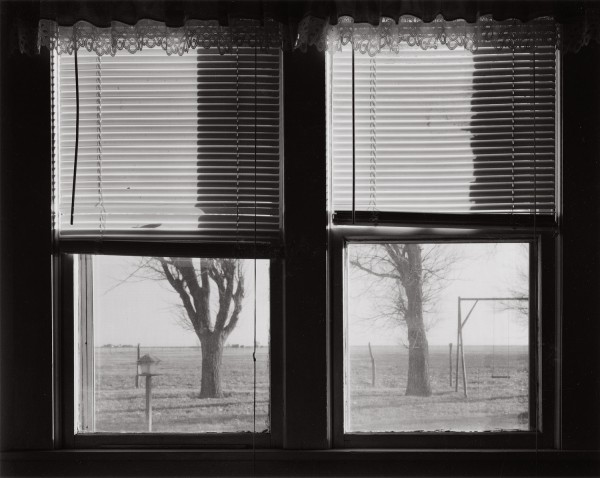
Paula Chamlee: Adrian, Texas, from the series High Plains Farm, 1995. Silver chloride contact print, 8 x 10 in. (203 x 254 mm), 1995/1995, on original mount. 16731.
"I grew up on a family farm on the high plains of the Texas Panhandle, located near the small town of Adrian, a town of about 300 people on Route 66. Amarillo was the only nearby city (48 miles to the east) where one could see a doctor or go to a cattle auction. It was a rural life where the word "art" scarcely existed. We all helped out on the farm and learned to drive tractors, trucks, pickups and cars by the time we were nine or ten years old.
"I was very different from the rest of my family. I was a dreamer. I always imagined that I would become a ballet dancer, an opera singer or an actress. While I'm very much influenced by and connected to the land out there, it was so isolated that I couldn't wait to get out. There were no art classes of any kind. There was music, and we did stage plays. There was a thing called the Interscholastic League in Texas where schools competed with each other on district, regional and state levels for many different subjects—science, math, English, debate, poetry interpretation. And stage plays were part of it. I did a lot of acting and I won some awards for it, which in 1963 led to a scholarship in speech and drama at Texas Tech University in Lubbock."
How did your parents react to your educational direction?
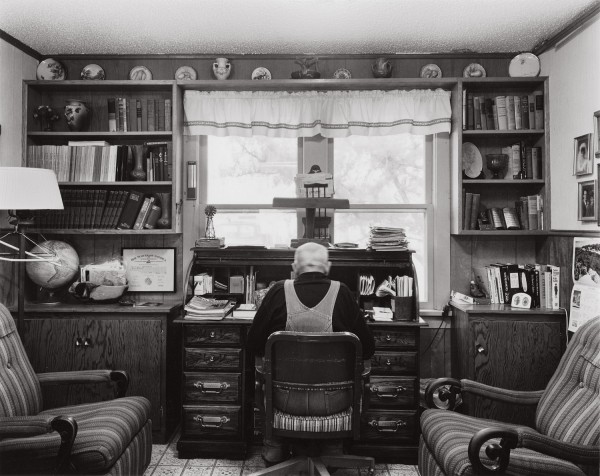
Paula Chamlee: Adrian, Texas, from the series High Plains Farm, 1994. Silver chloride contact print, 8 x 10 in. (203 x 254 mm), 1994/1994, on original mount. 16726.
"The best thing my parents did for me was to leave me alone. I think they figured, 'Oh well, she'll go to college and she'll get married and have a family, and that'll be her life's work.' That was the model back then. I was born at the end of 1944, and for my generation, everything was changing in America. The economy was improving, cars and clothes were becoming more colorful, and things were getting better overall economically. Life had been very different for my parents. They had barely survived the Great Depression and the Dust Bowl years. They had an ethic of survival that permeated everything we did. 'Use it up, wear it out, make it do or do without.' You must never be in debt, because this could happen again through no fault of your own.
"I had everything I needed, not necessarily all the things I wanted, but things were okay. Dad was very careful. When he had good crops, or good years, money was put aside for the bad years that were to come, probably from drought or a crop getting hailed out. Anything could happen. Being careful and conservative with resources has always been important to me."
What were your experiences like at Texas Tech?
"I was in stage plays and studied speech and drama, but I wasn't doing so well in my other classes. I had come from a tiny school and then to a big university. And I was having a ball instead of studying. I met guys I hadn't grown up with and that was exciting.
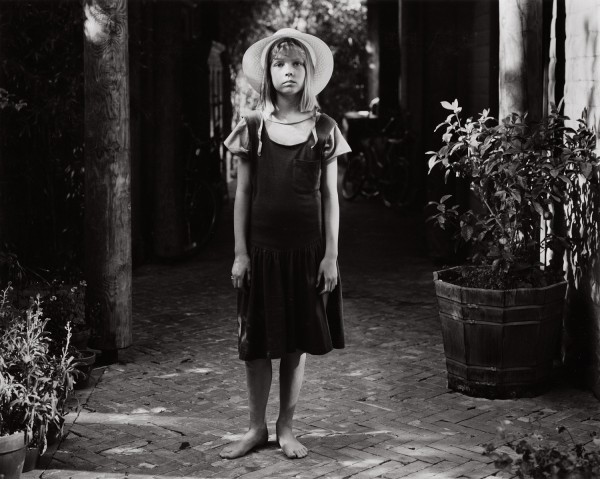
Paula Chamlee: Garnett, Tucson, Arizona, 1990. Silver chloride contact print, 8 x 10 in. (203 x 254 mm), 1990/1990, on original mount. 16723.
"Here I was in middle America in the mid 60s. There were lots of things happening on the East Coast and the West Coast—the hippie movement, the drug culture, etc., but that hadn't quite reached where I was in Texas. I think I'm really lucky in that regard, because I would have said, 'Oh, I'll try that.' Well, I was not doing so well with my grades so I decided to take a break from school in my sophomore year.
"In 1965, at the suggestion of one of my dorm mates, I interviewed and was hired by Delta Airlines as a stewardess, as we were called back then. It was perfect because I had always wanted to travel. While the Civil Rights Laws had been passed by that time, they weren't being fully observed by some corporations. There was a policy that stewardesses couldn't be married. Having met my first husband while I was based in New Orleans, I had to leave my job when we got married at the end of 1967. Then I got a job in television as a news reporter, followed by a stint in real estate. We lived in Mobile, Alabama, then Chicago, where I worked as an assistant to the PR director of a chemical company, which is where I learned typesetting, designing and writing for their company newsletter, hard-copy print media."
When did the visual arts enter the picture?
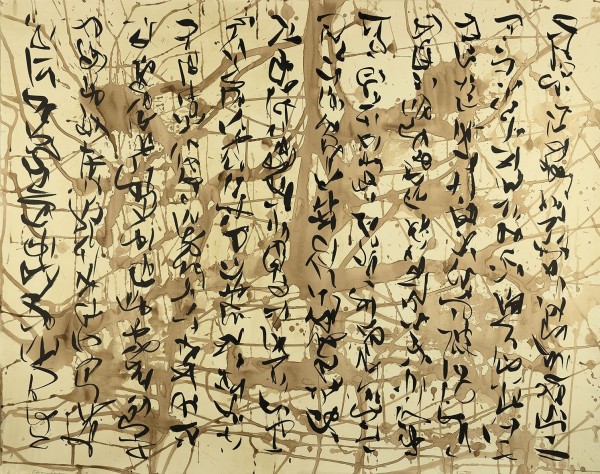
Paula Chamlee: Writing #35. Sumi ink over flower pigment wash, 32 x 40 in. (813 x 1016 mm), 2014/2014, unmounted. 16930.
"I had a friend who was a painter, a very good, realist painter. His work seemed so interesting that I asked him if he would give me lessons. It turned out that other people had asked him the same thing, so he got a small group together. I soon realized, 'I'm not bad at this. I think I can do this.' Then my first husband and I were stationed overseas for a year with his company, first in Manchester in the north of England, then in Basel, Switzerland. By that time, we had two young children, aged three and seven.
"While in Manchester, we would often travel to London, and while he attended business meetings, I would go to museums, mind-boggling experiences for me. I absorbed as much as I could because I had not been exposed to big museums and the broader art world where I grew up. When we came back to the states, my kids were almost ready to be in school full-time, and I decided to go back to school and finish a degree I had not finished previously.
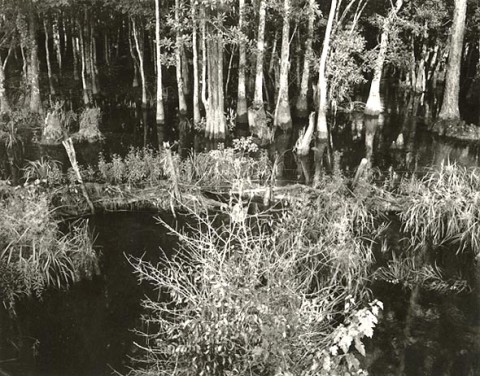
Paula Chamlee: Swamp (Bayou Le Batre), Alabama #3. Silver print, 3-3/4 x 4-3/4 in. (95 x 121 mm), 1989/1989, on original mount. 7224.
"At the University of South Alabama in Mobile, I studied French (I'd had to learn some German while we lived in Switzerland), and I took all of the art history classes. They didn't have a photography department, but they had a really good art department. I studied the history of art, painting, drawing, print making, ceramics and sculpture.
"Then I discovered that a History of Photography course was being offered and I thought that sounded really interesting. Back then they used Beaumont Newhall's History of Photography as the main text, and the course was taught by a man named Dr Michael Thomason, to whom I am forever indebted for his great knowledge of photography."
Can you tell me about the course?
"Photography was a bit of a stepchild in the art department, as there was no designated photography department. Dr. Thomason had worked with view cameras and several other aspects of photography and was responsible for establishing a beginning class on how to develop film and make basic prints—and it grew from there. Through him, I met some serious photographers who lived and worked in Mobile.
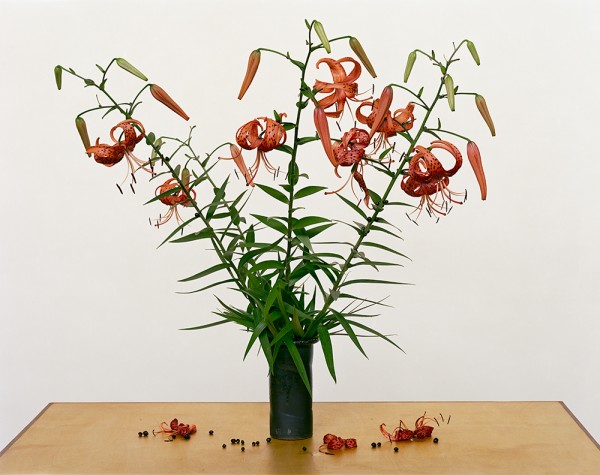
Paula Chamlee: From the series "From the Field." "Turk’s Cap Lily, 2013” . Pigment ink print on archival paper, 50 x 65 in. (1270 x 1651 mm), 2013/2018, on di-bond with wood framework on verso. 15873.
"The real turning point for me was when I came across a book of Edward Weston's photographs. I was immediately taken with their sensual nature and the rhythm and structure of the photographs. They related directly to the way I painted and drew. Something clicked and I thought, 'I need to know more about this person,' so I immediately did my semester paper on Edward Weston and studied all the other master photographers as well. And because of Dr. Thomason, the University Library had amassed a very fine selection of photography books by the great photographers, along with technical books.
"I found that photography felt so right that I was painting less and photographing more, so by the time I did my senior exhibition, it was about two-thirds painting and one- third photography. Then one day, I saw another photographer's two and a quarter-inch negatives and thought 'That's better.' So I borrowed my husband's Yashica reflex camera and started using that, and I found people who could teach me how to print better. Then I saw someone's four by five-inch negatives, and I said 'That's even better', and I borrowed a good friend's four by five camera, lenses and tripod, and started photographing with that. I bugged Dr. Thomason until he taught me how to use the view camera. Eventually he said, 'Paula, I've taught you everything I know. Go make photographs!' So I did."
Just how different was it to work with a four by five camera?
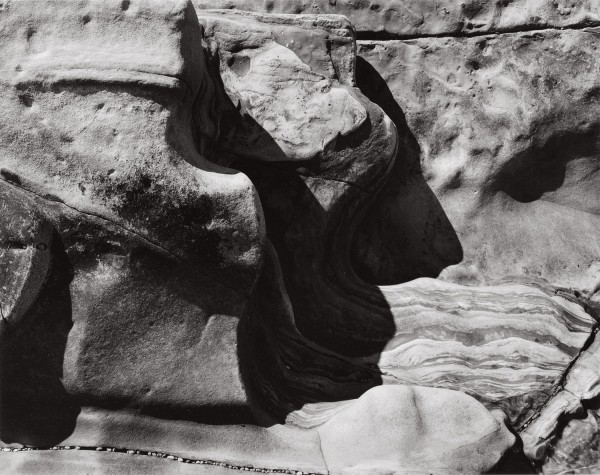
Paula Chamlee: Point Lobos, California, 2002. Silver chloride contact print, 8 x 10 in. (203 x 254 mm), 2002/2002, on original mount. 16736.
"It immediately changed the way I saw the world. When I looked on the ground glass and things were upside down and backwards, my reaction was, 'This is perfect. Now I can see the world for how it looks, and not what it is.' I think it's very difficult for us to forget what things are, especially as adults, because we name things, and once you name something, there's a value judgment placed on it. If we could see the world like very young children who think everything is luscious visually because it's new, then there's no judgment about what it is, and anything can be visually interesting."
What kind of work were you producing at that point?
"It was somewhat derivative at first because I wanted to learn from all the master photographers. I thought I was doing it my own way, but I knew that I hadn't fully developed my own vision yet. I still had to learn about what makes a great photograph, no matter what the subject is. I was looking at Cartier-Bresson, Kertész, Stieglitz, Steichen, the FSA photographers, all of them. I was absorbing thousands of photographs and then, suddenly, my work wasn't derivative anymore.
"My own vision was emerging, and part of that came from the influences of painters, the way they resolve form in space. My first important painting influence was Matisse, followed by Cézanne and Kandinsky (prior to 1918). Later, I became very interested in Bonnard, Rothko and Richard Pousette-Dart, from whom I learned great lessons from his drawings. By copying paintings, I could see how the rhythm and structure was being resolved within the confines of the picture space. Studying painters fed into the way I understood how to organize form in space in a photograph.
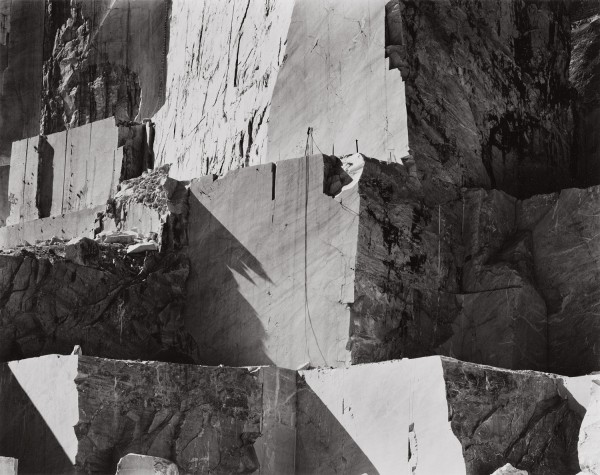
Paula Chamlee: Carrara Quarry, Colonnata, Tuscany, 2000. Silver chloride contact print, 8 x 10 in. (203 x 254 mm), 2000/2000, on original mount. 16745.
"By 1985, I had built a painting studio and darkroom in the backyard behind our house and called it Studio One. While in Mobile, I was also doing some commercial work, photographing objects for the local art museum, making portraits and photographing the paintings and sculptures of artist friends for their portfolios. I was learning how to do a lot of studio setups and lighting experiments, with no notion of where this new passion for photography would take me. My personal work was in black and white because I liked that sense of abstraction.
"By 1987, I had been photographing with the 4x5 view camera for about a year, which is when I met Michael A. Smith. He came to Mobile to teach a workshop with large-format photographers, and that was the first time I saw 8x10 negatives. And I thought, 'That's even better!' The workshop was also my first exposure to contact printing on Kodak's Azo paper. Until then, I had been enlarging my 4x5 negatives. It would be another couple of years before I got my first 8x10-inch camera, a Kodak Masterview, and doing contact printing without enlarging."
How much of a difference did the Kodak Azo paper make?
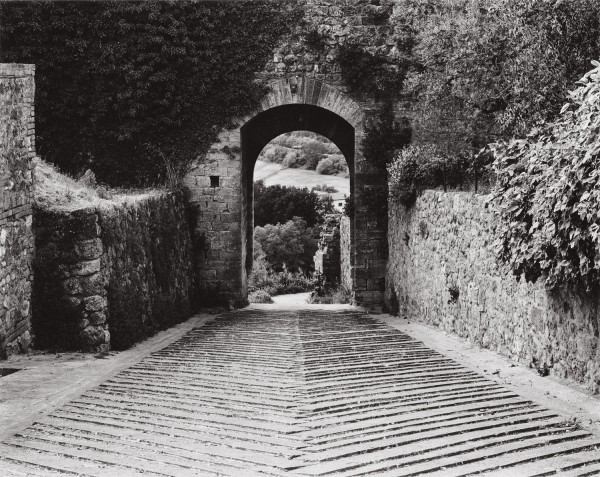
Paula Chamlee: Monteriggioni, Tuscany, 2000. Silver chloride contact print, 8 x 10 in. (203 x 254 mm), 2000/2000, on original mount. 16749.
"I thought my prints up until then looked really good, but the Azo contact printing paper made a huge difference. I realized I needed to learn more about materials and printing techniques to improve my work. I had already graduated from the University of South Alabama with an MFA by then.
The people that I was photographing with in Mobile and I started a small photo gallery called The Keepers of Light Gallery, named after the book by William Crawford. We invited guest speakers like William Christenberry and Olivia Parker, and we had our own work on the walls all the time.
It was a co-op gallery, but was pretty short-lived because it didn't make any money. Still, it was a fun and useful part of the journey."
The workshop was important in another way. Michael A. Smith became your second husband.
"Michael changed my life. We never spoke on the phone after that first meeting in the fall of 1987. We got to know each other through hand-written letters. No personal computers or email at that time!—and we never talked about photography. It's a Bridges of Madison County story, and in the end, I left my first husband for Michael. All very scandalous and problematic. By then, my daughter was in college and my son was in high school.
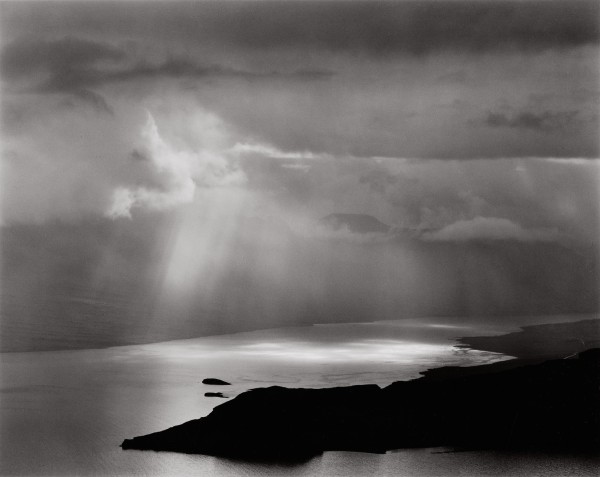
Paula Chamlee: Reydarfjördur, Iceland, 2004. Silver chloride contact print, 8 x 10 in. (203 x 254 mm), 2004/2004, on original mount. 16757.
I moved to Pennsylvania to live with Michael. I had developed my photography quite a bit by that time and Michael and I started taking photographing and sales trips together. We would travel across the US to meet collectors and curators in order to raise money for our work. That's how we became friends with lots of museum curators and collectors around the country. It was wonderful. The curators would sometimes give us the names of photo collectors associated with their institution. They liked meeting artists and hearing the stories behind the work. As the photo world grew, everything changed. But those trips were crucial because we didn't have teaching pensions from universities and needed to make print sales in order to pay the bills and keep making photographs and books. Trips that we made in our photo trucks were equipped and devoted solely to making photographs."
You have always been drawn to abstraction, and it seems that the subject matter is less important than what you can do with it.
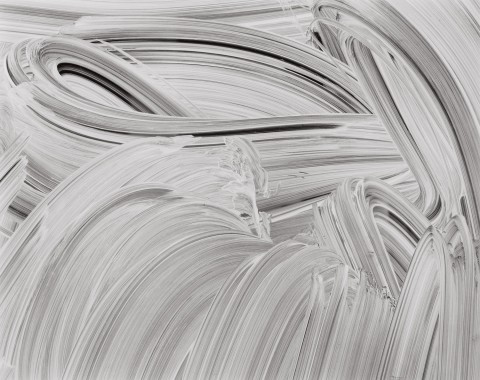
Paula Chamlee: Akureyri, Iceland, 2004. Silver chloride contact print, 8 x 10 in. (203 x 254 mm), 2004/2004, on original mount. 16756.
"I want to make photographs that are more than what they are of, and that's something that Michael and I would teach in our workshops, and something I continue to teach. Michael often stated, 'It's how one sees, not what one sees that makes any photograph interesting.' In the end, it's intuitive. I like that fine line between photographing something completely realistic in terms of sharp focus throughout the picture space, while being completely abstract."
Looking at your work, I'm reminded of critic Robert Hughes, who once referred to certain works being examples of slow art. Works that take time to fully reveal themselves.
"I agree. If you get it at first glance, there's not much there. I think it was Eugene Smith who did a show where he hung photographs from floor to ceiling, and somebody came up to him and said, 'Those down below are hard to see!' And he said, 'Well, they were hard to make!' I think my work needs time when being viewed. It's like one's soul is sort of floating in there somewhere."
Alfred Stieglitz took a series of cloud pictures, Equivalents as he called him. Some people might say, "They're just a bunch of clouds." But he was using the clouds to express exactly what he was feeling at that point in clouds. When you look back at your work over the years, can you see in the images where you were at emotionally?
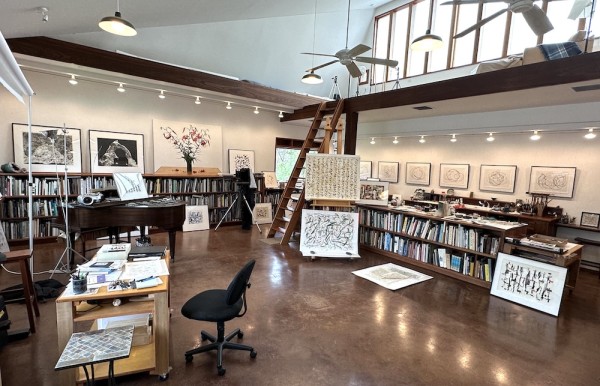
Paula's studio, library and workspace. Photo credit: Paula Chamlee.
"Oh, that's a good question. I think so, because, as I've developed as a photographer and as an artist in general, I hope I've also developed as a human being, and that naturally feeds itself into the work. When I do new work, I don't want to repeat myself. I want to try to just go a little deeper and do something not necessarily for the sake of being different, just finding something more interesting for myself, with a sense of discovery that helps me feel like I'm growing emotionally, spiritually, mentally, physically, whatever.
"When Michael started getting sick and we couldn't travel anymore, I was spending more and more time in my painting studio. He passed away in November 2018, and he was not well enough to travel for a couple of years prior to that. Being in the studio provided more time for photographing still life and some of the objects I was making—assemblages, collages, sculpture and sumi ink drawings.
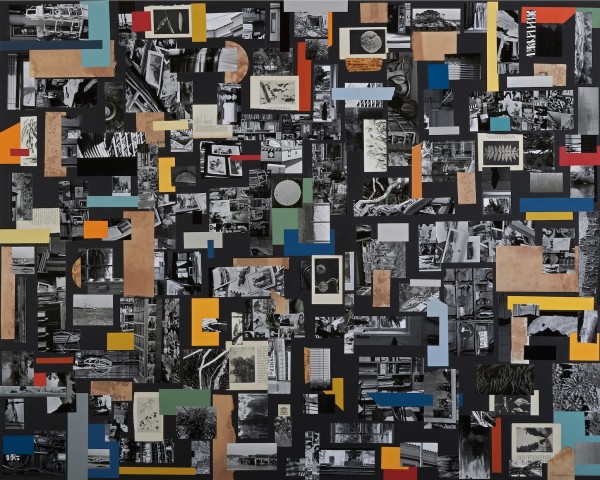
Paula Chamlee: The Time Between. Collage: photographs from gelatin silver contact prints, painted and printed papers, bark, 32 x 40 in. (813 x 1016 mm), 2016/2016, on archival board. 16923.
"Photography is integrated into a lot of the collages and paintings, and that made me look at things differently because I was working with different materials. In my experience, various mediums inform each other. I'm also doing work in color. I've been trying to do a book for the last few years called the The Cosmos in My Room. It is a kind of autobiography of where I am at this point in my life. And for the first time, I'm working with digital capture. When I'm photographing with a digital camera, I'm working with a tripod, and it seems to take just as long to make an exposure as with an 8x10, because I want each frame to be perfect. Having said that, I'm overwhelmed with all the other things I have to deal with."
Such as?
"Since Michael passed away, I have to manage everything here by myself in addition to our nonprofit organization, Arts of our Time. I have wonderful board members, but most of the work falls to me. Michael and I established Arts of Our Time in 2013. We gave our 28 acres of land and our compound with four studio buildings. Michael wanted to spend the last 10, hopefully 15 or 20, years of his life to building and managing the nonprofit, and that means not only construction, but also fundraising and programming. And then he died. As a result, I spend a lot of my time fundraising, trying to finish construction of one of the buildings. Hopefully, I can finish that before I die.
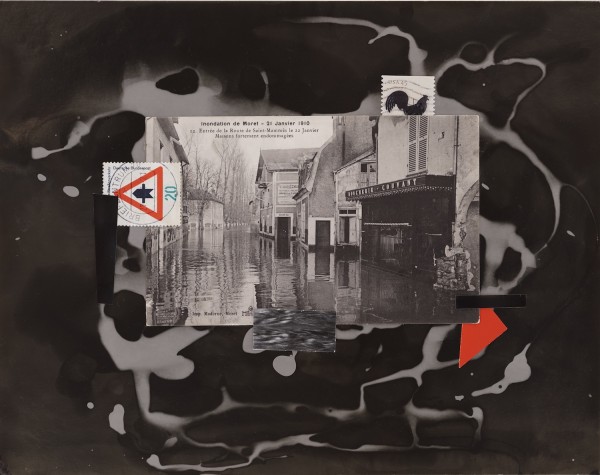
Paula Chamlee: Inundation de Moret. Collage of chemically altered photo paper, antique French postcard, stamps, painted paper, 8 x 10 in. (203 x 254 mm), 2026/2026, on archival board. 16920.
"In the meantime, I'm managing everything else administratively by myself so there is not much time to do much new work. I also I need to publish a very important book of Michael's that we were working on before he died, and it's really important to his legacy, so I have to raise the money for design and printing of that book, and the new one of mine. I've got a lot on my plate—but it's a Life."
I assume the two books will be published by Lodima Press, the publishing house that Michael founded and you became co-owner. In addition to books of your own work, you have also published books by other photographers, Edward Weston, Robert Adams, Larry Fink and many other well-known photographers.
"Yes, they will be Lodima Press books. And I want them to be high-end, like all of our other books, and that's expensive. I'm also managing sales of our photo printing paper that replaced Kodak's Azo, which is manufactured in Europe.
That's certainly devotion to fine art photography. Why did you and Michael take this project on?
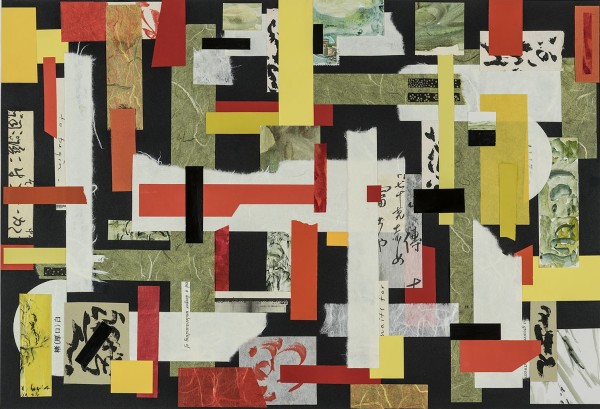
Paula Chamlee: A Deeper Understanding. Various papers, photographs, sumi ink, watercolor, 13 x 18.5 in. (330 x 470 mm), 2013/2013, on black Artcare board. 16925.
"We were completely nuts! I can't tell you how far out on a shaky limb we were with that project. Because we've never had any extra money, we borrowed from our credit cards and from many photographers to just to pay for the R&D. That went on for five and a half years before the paper was actually produced. The photographers who lent funds were the first ones to get the paper and at a discount. It was crazy, but Michael and I always had the same philosophy: When you work in a medium that has been good to you, you give something back. That has been the guiding light in our teaching and we have always been generous with our knowledge. No secrets, nothing held back. Getting that paper made was a miracle. Everyone, including Kodak, said what we were trying to do would be impossible. I can't believe we did it. And when Kodak discontinued Super XX film, we bought all of their remaining supply and built a freezer in which to store it and to have a lifetime supply of film. Since Michael passed away, I've sold a lot of it to photographers who love this extraordinary film.
I wanted to ask you a little bit about you and Michael, and how you went on photographic trips together, to Chicago. for instance. He was photographing the Chicago Loop. You were photographing along the lakeshore. It resulted in a flipbook. How did your discussions go and how did you keep your individual visions?
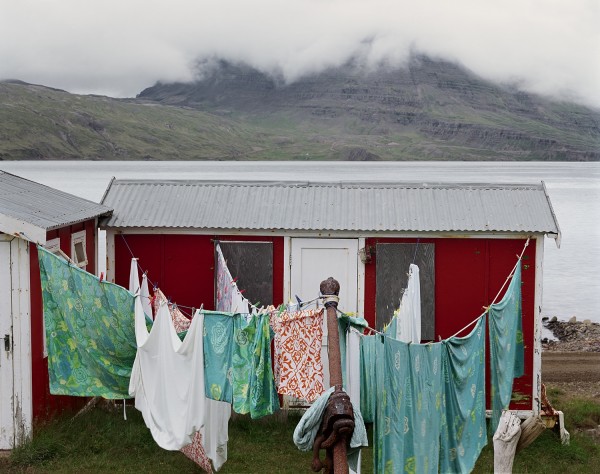
Paula Chamlee: Djupavík, Iceland, 2010. Pigment inkjet print on archival paper, 16 x 20 in. (406 x 508 mm), 2010/2010, on original mount. 16763.
"When we did the Chicago project, we had two separate vehicles, and we each had our own assistants. We would be gone from each other all day. Only occasionally did we share the same location. Our sponsor, US Equities Realty owned or leased many of the tall buildings in Chicago so we had security clearance and access to the rooftops of high buildings, and sometimes we both worked from that vantage point. But my focus was entirely on the 26 miles of Chicago's public lakeshore. Michael had always wanted me to combine my writings, my sketches, watercolors and various assemblages with my photographs. So, to accommodate the long format of the book necessary for Michael's 8x20s, I needed a way to position my 8x10 prints on that format. I combined them with drawings and other mediums to fill out that space.
"Although we usually, not always, traveled and photographed together, we never collaborated on a project—except one. That's another story. And we never, ever, printed together. That would have meant divorce! The dark room was sacred. When I was working in my painting studio, Michael never interrupted me unless I asked him to. When we did books together, we would both work out design ideas and sequencing separately and then go over it together. Michael was not ego driven at all. He often said, 'I would be thrilled if you were more successful than I am.' An unlikely prospect, as he'd been photographing much longer than me."
I was wondering about the relationship between your photography and your painting, if there are links there, and how they differed for you.
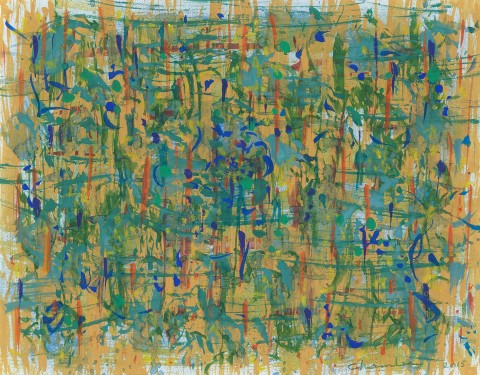
Paula Chamlee: With Blue. Watercolor, gouache, oil stick, 8 x 10 in. (203 x 254 mm), 2015/2015, on archival board. 16924.
"There is definitely a consonance between the two and how I resolve form in space with painting, whether it's in color or Sumi ink and charcoal on paper. In my experience, various mediums inform each other and expand my visual sensibility. Whatever the medium, the goal is always to make a strong picture. And for me, I suppose that's basically subconscious, because I don't think about it. Once I've resolved something on a piece of paper or a canvas, I might instinctively find a new way to resolve how something fits into my camera frame."
You have traveled within the US, to Iceland, Tuscany and many other countries. Has it been important to you to remove yourself from your immediate surroundings and be confronted by something different?
"Very much so. Michael and I always said that you can make good photographs anywhere, but if you're at home and you're answering the telephone and answering emails, writing letters, dealing with administrative tasks, you're constantly distracted. We took trips, together or separately, to immerse ourselves solely in seeing photographically. It meant that we could get away from the things that were impeding new work. New places are interesting because they challenge you to make sense of it, get beneath the surface, and to make good photographs there.
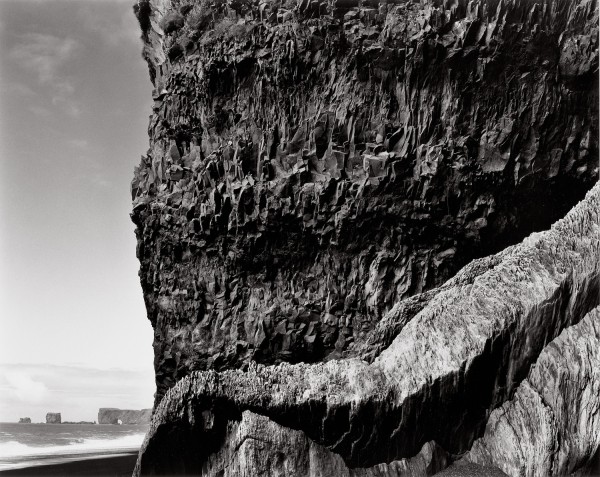
Paula Chamlee: Reynisfjara, Iceland, 2006. Silver chloride contact print, 10 x 8 in. (254 x 203 mm), 2006/2006, on original mount. 16759.
"On one of our first trips out West, Michael was eager to show me Canyon de Chelly, a magnificent place that belongs to the Navajo Nation. It felt quite overwhelming at first. (This canyon is known to be very sacred ground.) My first response was, 'I can't photograph here.' However, by the next morning, I said, 'Now I can photograph in this place.' I felt I needed time to connect and get a sense of permission. That's why my first book was called Natural Connections. Whatever I photograph, be it someone's interior, their portrait, landscapes, cities, whatever, I try to be fully 'in the moment.' The painter John Marin expressed this beautifully. Having been asked how he went about painting a landscape, he said, 'First, I bow to the landscape, and if the landscape bows back to me, I begin to paint.'"
Does this relate to what I asked before, about Robert Hughes and slow art? Of not being a tourist in a specific place, but actually being emotionally part of it?
"That makes perfect sense to me, because wherever I have photographed, I have to tune in. And once I tune in, things seem to work organically. The uniqueness in all of us comes through in our work. I think making one's photographs is autobiographical."
You started in analog. How did you respond to digital technology?
"I thought it was very interesting, but very intimidating for me. I know everything I need to know about my analog cameras, my lenses, my exposures, my entire process. Now I've had to learn something very different in order to make photographs with a digital camera. It's just a different process. As long as one has a good vision and access to the best materials for making photographs and prints, I don't think the medium matters.
"Michael and I first integrated our work with digital technologies many years ago when we bought a drum scanner and large printer in order to scan our large negatives, both black and white and color, for making big prints for museum exhibitions and collectors. It took a long time to find the perfect balance between all the moving parts of a digital system. Huge credit goes to Richard Boutwell, our collaborator and long-time tech guru who works his magic in our scanning and printing studio."
There's one group of images that stand out from your other work you have done, the nude collages, made in 1998.
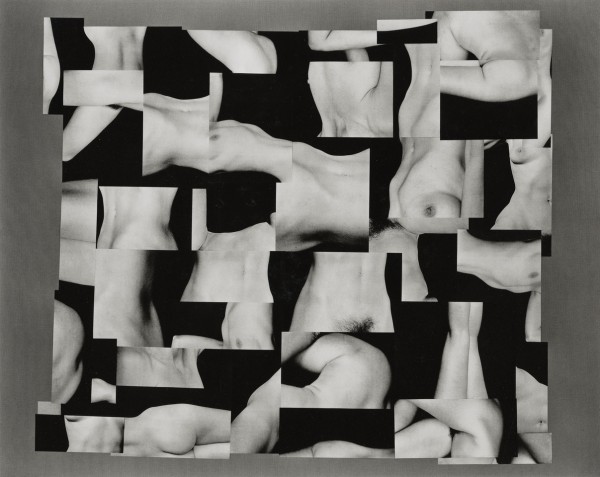
Paula Chamlee: Nude Collage #1. Silver print, 18-1/4 x 22-3/4 in. (464 x 578 mm), 1998/1998, on original mount. 16556.
"Those started in the mid-1990s when Michael made a series of nudes of me. A collector had asked to see the series. He lived in another state, so we made Xeroxes of them to send. No email at that time. They were all 8x20s so I had to put them on the copy-machine platen twice, and then cut and tape them together. While I was doing all this cutting, the remnants looked interesting to me, so I gathered them up and started making collages. Alex Novak of Contemporary Works/Vintage Works has this series of four for sale and currently represents my photography work. Although the collages are one-of-a kind pieces, I made them to be photographed so that the irregular edges of the collage against a background are part of the picture made with the 8x10 camera. I suppose you could call that my and Michael's first collaboration. It was a really fun series, and was my earliest collage work done here. After my painting studio was completed around 2003, I was able to make many more unique works in photography and other mediums.
Are you still carrying on with your educational work and the workshops?
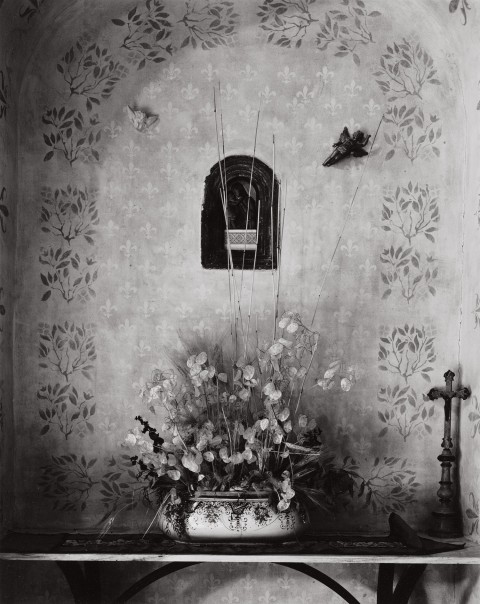
Paula Chamlee: La Chiara di Prumiano, Tuscany, 2000. Silver chloride contact print, 8 x 10 in. (203 x 254 mm), 2000/2000, on original mount. 16748.
"Yes. In 2019, I taught three workshops in China in three different locations. (I returned home at the end of 2019, one month before the warnings about Covid-19 were being publicized. Got out just in time.) In 2022, I taught at the National Institute for Applied Sciences in Lyon, France, and then visited some photographers in Romania in 2023. These days, I'm teaching privately or in small groups here at our home studios. I also review portfolios and do consulting work on how to make a fine photography book. Life is a continuous education; I'm trying to stay open to all of it.
To see and order photographs, collages and paintings by Paula Chamlee, go here: https://iphotocentral.com/common/result.php/256/Paula+Chamlee/0/0/8.
To order Lodima Press photobooks, archival materials, photographic paper or to attend photo workshops or consulting services run by Paula Chamlee, go here: https://www.lodima.org.
In 2003, Arts of Our Time, a non-profit 501(c)(3) organization was formed in Bucks County, Pennsylvania for the purpose of fostering scholarship and creativity in photography and other arts. The art of photography will always be central to Arts of Our Time.
Artists Michael A. Smith, photographer, and Paula Chamlee, photographer and painter, have a significant presence in the art world (between them, their photographs have been collected in over 150 art museums). Since their home and studios are artist-designed, it is appropriate that these buildings become a permanent resource for artists and art-lovers.
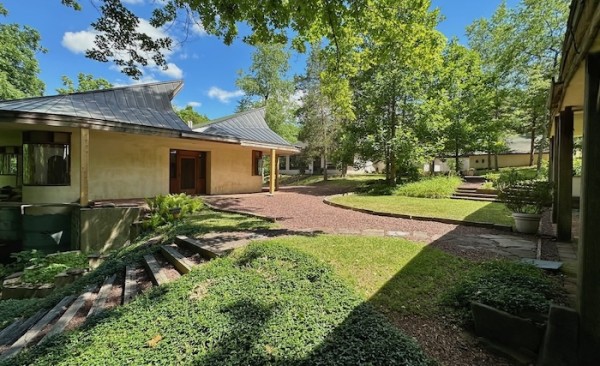
The Arts of Our Times was created to preserve the property and hand crafted buildings in Buck Country, PA, as well as the artwork of artists Michael A. Smith and Paula Chamlee. Since their home and studios are artist-designed, it is appropriate that these buildings become a permanent resource for artists and art-lovers.
The original impetus for Arts of Our Time was to house Smith and Chamlee's extensive archive of artworks, letters, books, and other published materials at their home and property in beautiful Bucks County, Pennsylvania. This area is a place known for over a century where well-known artists have lived and worked, among them photographer and painter Charles Sheeler and photographer Aaron Siskind. The writer James Michener and woodworker and designer George Nakashima also lived near Smith and Chamlee's property. This area of Bucks county, along with nearby Lambertville, NJ, was--and still is--considered an artists' colony.
As plans evolved, they realized that it could be much more—a place open to the public as a forum for dynamic programs that further education in photography and other arts, as well as exhibitions, performances, and residencies.
To get more information on the Arts of Our Time non-profit, go here: https://www.artsofourtime.org. Please make a donation here: https://www.artsofourtime.org/checkout/donate?donatePageId=6a29e008df6d743e11427f79. All donations are tax deductible within the limits of the law. This is a special place and should be supported and protected.
Michael Diemar is editor-in-chief of The Classic, a print and digital magazine about classic photography. In August 2025, he cofounded Vintage Photo Fairs Europe, an organization focused on promoting independent tabletop fairs in Europe and spreading knowledge about classic photography in general. He is a long-time writer about the photography scene, writing extensively for several Scandinavian photography publications, as well as for the E-Photo Newsletter and I Photo Central.
Interview: Paula Chamlee: An Artist of Complexity and "Natural Connection"
NY MoMA Hires Makeda Best as Its New Chief Photo Curator
Nearly 100 New Photographs Recently Added to the I Photo Central Website, Which Now Has Over 4,500 Photographs for Sale
Iconoclast, Provocateur and Innovator Duane Michals (1932-2026) Passes away
Photo Collector and Historian Jack Wilgus Passes away after a Fall


Share This